
I love a good worship album. I’ve been listening since the late 1980s. One of my favourite early albums features a song led by British songwriter Graham Kendrick titled, “Lift high the banners of love.” I’ve listened to the album countless times. Spliced into the heart of Kendrick’s song is an interlude where he declares:
Let’s by faith surround the Jerichos of our lives
The strongholds of evil that oppress us
And proclaim the victory of the cross
with a great shout of triumph: The Lord reigns!
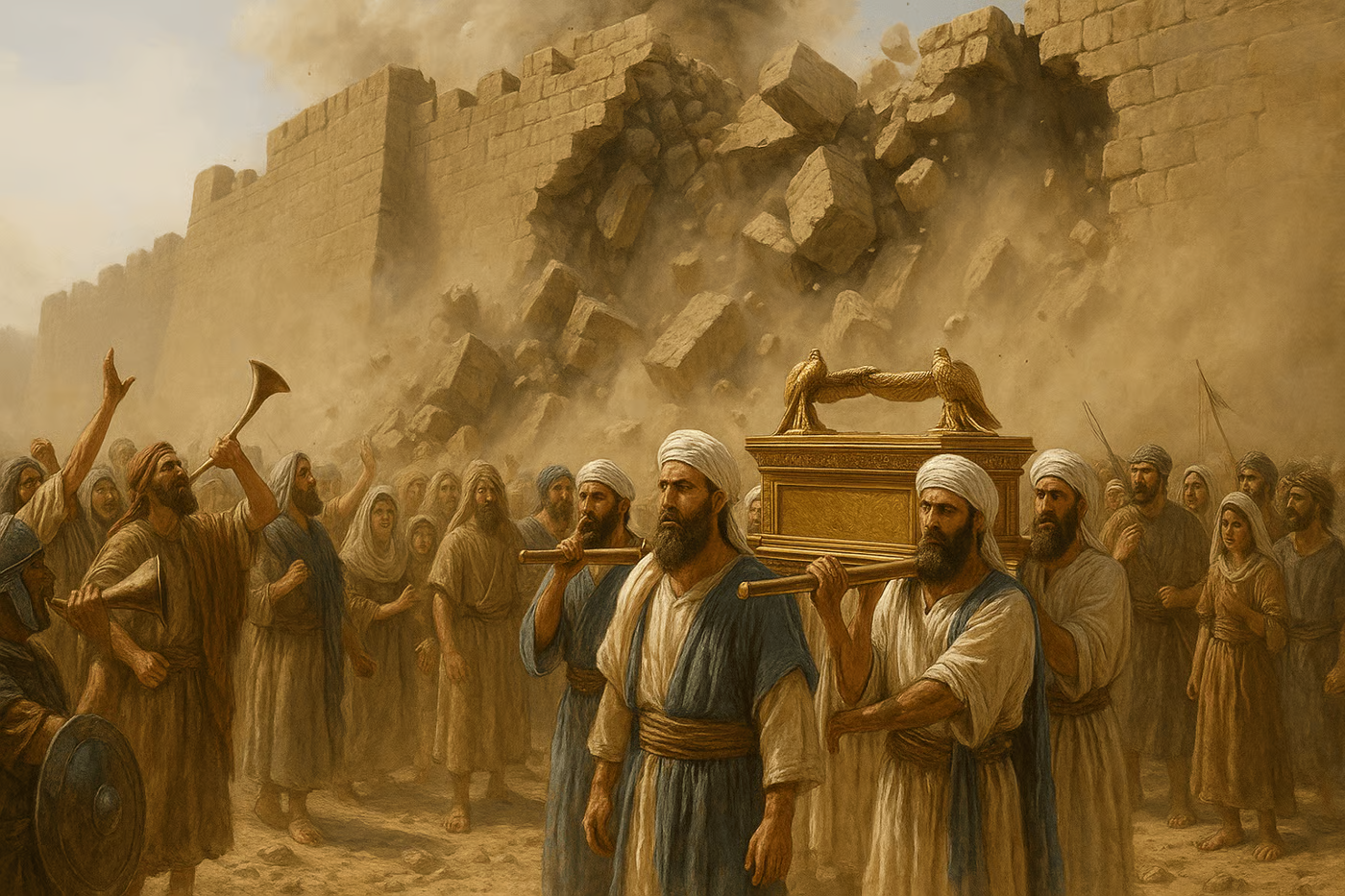
“Let’s by faith surround the Jerichos of our lives.” This powerful sentiment draws on the biblical story of the Battle of Jericho (Jos 6). As the Israelites marched in faithful obedience around the walls of Jericho, expecting God to tear them down, Kendrick encourages us to:
- Identify our personal “Jerichos”: our struggles, doubts and fears;
- Step out in faith: to take steadfast, faithful action to overcome personal problems, even when the way forward is unclear;
- Proclaim the victory: to choose the way of prayer, praise, and bold declarations of faith as our spiritual weapons, trusting that the metaphorical “walls” will dissolve into rubble.
At its best, the phrase captures several important biblical truths.
First, the story of Jericho emphasises that God is the ultimate source of victory. It wasn’t through military ingenuity but through obedience to God’s command that the Israelites conquered Jericho (Jos 6:1-20).
Second, the metaphor encourages perseverance. The Israelites marched around the city for seven days without visible evidence that anything was happening. Likewise, Christians are often called to endure faithfully despite uncertainty, trusting God’s promises rather than immediate results (cf Heb 11:30).
Third, the language of prayer, praise, and faithful action resonates with New Testament teaching. Christians are exhorted to persevere in prayer (Lk 18:1-8), to worship amid adversity (Ac 16:25), and to trust God even when circumstances don’t improve (2 Cor 5:7).
However, the events of Joshua 6 are not a lesson in overcoming obstacles but part of God’s covenantal judgment upon Canaan and the controversial establishment of Israel in the promised land. The narrative’s primary focus is on God’s faithfulness to promises made to Abraham centuries earlier (Gen 12:1-3; cf Jos 21:43-45).
Another problem is that the “Jerichos of our lives” approach implies that if we are sincere, and we persist in faith, every obstacle will disappear. The New Testament presents a more complex picture. For example, the Apostle Paul prayed repeatedly for the removal of his “thorn in the flesh,” yet God did not remove it (2 Cor 12:7-10). Paul learned instead that divine power is perfected in weakness.
Many faithful Christians throughout history have endured persecution, disability, bereavement, or injustice without experiencing a dramatic earthly resolution (cf Heb 11). Biblical faith does not guarantee that every “Jericho” of our lives will collapse if we just have enough faith.
Joshua’s military victory belongs to an early stage in salvation history. The classic pattern of Christian discipleship is not conquest but cruciformity, not the way of the sword but the cross. The New Testament reinterprets personal victory through the death and resurrection of Jesus who triumphs not by destroying enemies but by loving them, suffering for their wellbeing, and overcoming evil through self-giving sacrifice (Col 2:15; Php 2:5-11).
Some of our “Jerichos” are not meant to be conquered but carried. Yes, God calls us to ultimate victory and glory as we align our lives to the cause of Jesus, but God also calls us to endurance, patience, and participation in the sufferings of Christ (see Rom 8:17; 1 Pet 2:21).
The Book of Joshua is primarily concerned with Israel’s transition from wilderness existence to settled life in Canaan. The narrative belongs within a larger biblical story of land, covenant, nationhood, and divine purpose. The central question the text wrestles with is, “How does Israel understand its identity, vocation, and relationship with God?”
The story raises difficult moral and theological questions. Jericho is not merely a defensive wall that miraculously crumbles. Its destruction is an act of divine judgment against persistent evil. The inhabitants are annihilated under the principle of “the ban” (Jos 6:21). We can’t responsibly engage with the story of Joshua 6 without confronting the reality of divinely sanctioned violence.
And it’s not just that: History provides sobering and discomforting examples of the use of such narratives to perpetrate further violence, often with no connection to biblical ideals. European colonists appealed to Joshua when dispossessing Indigenous peoples of their lands. Nationalist movements employ conquest narratives to sanctify territorial claims. Religious extremists have invoked similar texts to legitimise violence. Such uses of Joshua represent precisely the kind of theological distortion that contemporary readers should resist.
Rather than asking, “Who are my Jerichos?” a more responsible and less individualistic question may be, “How have the conquest narratives in Scripture been used to construct enemy identities and justify violence and oppression?”
We should also be wary of those who claim divine approval for their political and ideological projects. Modern readers recognise that history is often narrated from the perspective of victors. The inhabitants of Jericho undoubtedly took a vastly different view of events to that of the people of Israel. Contemporary biblical interpretation encourages us to attend to marginalised voices and overlooked perspectives rather than too quickly side with the victors.
Here’s where it gets difficult, but also exciting and hopeful. Those of us who hold that Scripture is our authoritative guide to faith and living, and possesses eternal relevance, encounter a problem when we find that the Bible was originally written to people other than us, who lived a long time ago, in another part of the world, where they spoke a different language, and had different cultural practises and values.
Every text we encounter has multiple meanings. There is the meaning intended by the author, the meaning understood by the reader, and the literal meaning conveyed by the words and grammar of the text.
To boldly or courageously impose our own meaning on a biblical text will not necessarily help us discern what the text actually means. Experience teaches me that it’s not usually the voice of the Holy Spirit that I hear, but the voice of my own passions and will.
The biblical prophets repeatedly challenge Israel’s assumptions of divine favour. Scripture contains internal critiques of conquest theology. Books such as Ruth, Jonah, and Isaiah broaden the horizon of God’s theological and ethical concerns beyond ethnic Israel.
The New Testament reframes divine election and covenant around Jesus rather than territory or nationhood. The Bible itself encourages critical reflection on simplistic notions of divine endorsement and the inevitability of historical progress.
A critical theological reading of Joshua 6 yields insights quite different from those offered by popular devotional interpretations.
First, it reminds us that Scripture emerged within concrete historical struggles and cannot be detached from those realities without distortion.
Second, it warns against religious triumphalism and the temptation to claim divine endorsement for our own causes.
Third, it encourages careful reflection on the relationship between faith, power, land, identity, and violence: questions that remain deeply relevant in a world marked by nationalism, war, and ethnic conflict.
Fourth, it demonstrates the importance of reading difficult texts honestly rather than domesticating them by transforming them into comforting spiritual metaphors.
Finally, it points us toward the necessity of reading every biblical text through the revelation of God in Christ, whose victory is expressed through self-giving love rather than coercive power. The trajectory of Scripture moves from conquest to reconciliation, from tribal identity to universal mission, from holy war to peacemaking, from territorial inheritance to new creation.
The people of God today are called neither to imitate Joshua’s wars nor merely to spiritualise them into personal struggles against evil. We read the narrative, and engage with Joshua’s concern for covenant faithfulness, and interpret that concern through the life, death and resurrection of Jesus.
The result is a vision of God’s people as a holy community that exercises power with humility, understands identity in terms of holy vocation, and pursues faithfulness in a world intoxicated by success. Such a community bears witness to the God whose kingdom comes through the pursuit of truth, justice, mercy, and self-giving love.
In this light, the most important question raised by Joshua 6 is not whether we can “by faith surround the Jerichos of our lives.” It is whether, and how, amid the ambiguities of history, and the temptations of power, and the distractions of our culture, we are able to remain faithful to the God whose purposes are ultimately revealed to us in Jesus Christ.
Sermon 859 copyright © 2026 Rod Benson. Preached at North Rocks Community Church, Sydney, Australia, on Sunday 21 June 2026. Unless otherwise noted, Scripture quotations are from The Christian Standard Bible (Nashville: Holman Bible Publishers, 2020).
Rev Dr Rod Benson is General Secretary of the NSW Ecumenical Council and a minister of the Uniting Church in Australia serving at North Rocks Community Church in Sydney.
Image source: WatermarkWaves
Taking it further…
Reflection questions
- Why does the preacher argue that Joshua 6 is not primarily a lesson about overcoming personal obstacles? What does he suggest is the main focus of the biblical narrative?
- How does the example of the Apostle Paul’s “thorn in the flesh” challenge the idea that every problem will disappear if a person has enough faith?
- What concerns does the sermon raise about the historical use of Joshua’s conquest narratives in politics, nationalism, and colonial expansion?
Application questions
- The sermon suggests that Christian victory is shaped by the cross rather than conquest. How might this influence the way you respond to conflict, opposition, or difficult people in your life?
- Where do you see examples in contemporary society of people claiming divine approval for political, ideological, or national causes? How can Christians exercise discernment in such situations?
- The sermon concludes by asking whether we can remain faithful to God amid the temptations of power, the ambiguities of history, and the distractions of culture. What practical disciplines or habits help you remain faithful in these circumstances?

