
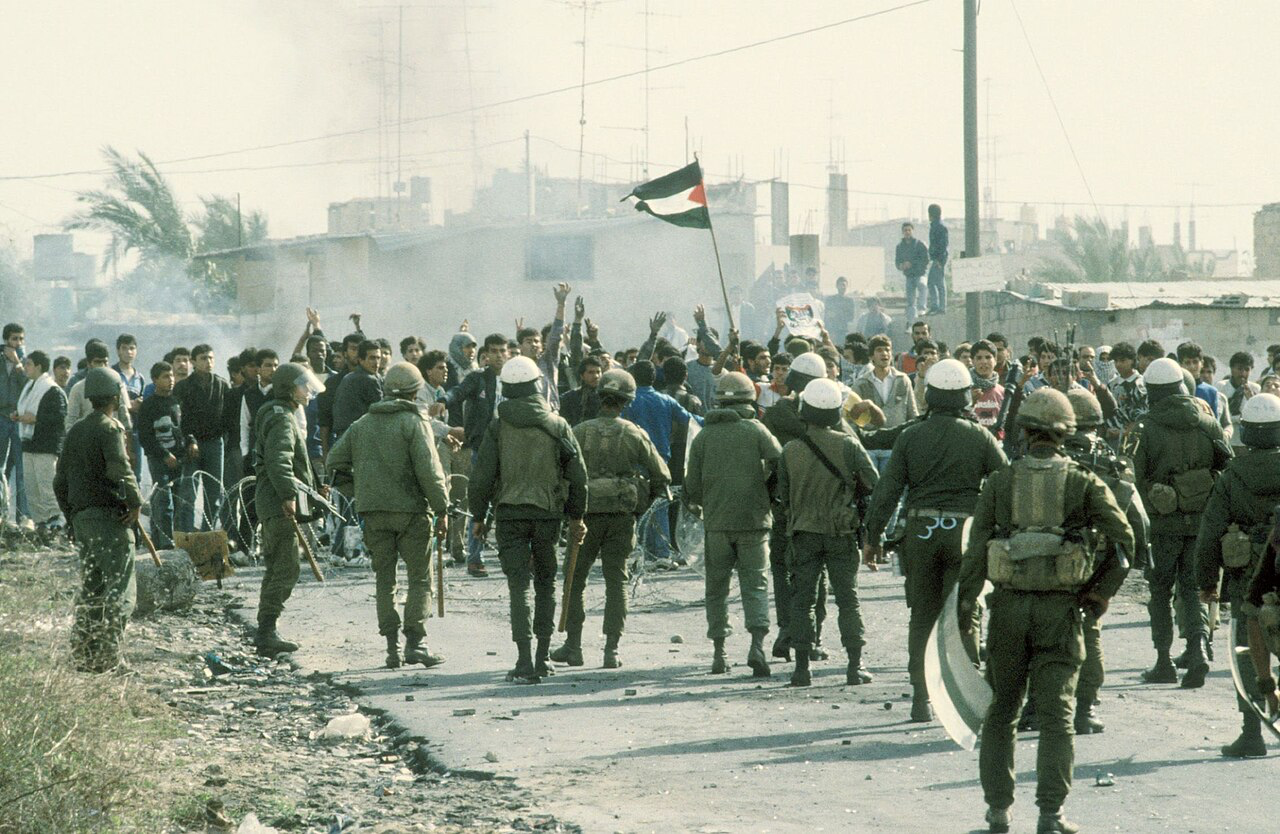
Historians of the Israeli-Palestinian conflict identify two highly significant moments in the long drawn-out conflict by the names given to them by Palestinians: the First and Second Intifada.
An overview
In Arabic, the word “Intifada “(انتفاضة) literally means “shaking off” or “uprising.” In the Israeli–Palestinian context, it refers to periods of sustained Palestinian resistance against Israeli rule in the occupied West Bank, East Jerusalem, and Gaza Strip. The term encompasses a range of actions, including civil disobedience, strikes, demonstrations, stone-throwing, armed attacks, and, depending on the period, organised militant violence.
The First Intifada (1987–1993) began spontaneously in December 1987 after years of frustration over Israeli occupation. It was characterised primarily by mass civil resistance, including strikes, boycotts, demonstrations, and stone-throwing, although violent incidents also occurred. Israel responded with military and policing measures. More than 1,000 Palestinians and around 160 Israelis were killed. The uprising transformed international perceptions of the conflict and helped create the political conditions that led to the 1993 Oslo Accords between Israel and the Palestine Liberation Organization (PLO). This article outlines the key features of the First Intifada.
The Second Intifada (2000–2005) erupted in September 2000 following the collapse of the Camp David peace negotiations and heightened tensions surrounding Ariel Sharon’s visit to the Temple Mount/Haram al-Sharif. A subsequent article outlines the key features of that conflict.
Beginnings of the First Intifada
The uprising began on 9 December 1987 in the Jabalia refugee camp in the Gaza Strip after an Israeli military vehicle collided with a car carrying Palestinian workers, killing four people. Israeli authorities regarded the collision as a traffic accident, but many Palestinians believed it was a deliberate act of retaliation for the killing of an Israeli several days earlier.
Whatever the immediate cause, the incident ignited long-simmering grievances. Within days demonstrations spread throughout Gaza and the West Bank, revealing the depth of frustration that had accumulated during two decades of Israeli military occupation following the 1967 Six-Day War.
The causes of the Intifada lay far deeper than any single incident. Palestinians experienced a repressive mix of military administration, restrictions on political activity, land expropriation, expanding Israeli settlements, administrative detention, and constraints on movement. Economic dependence upon Israel produced persistent unemployment and inequality, while a generation of young Palestinians had grown up knowing no political reality other than occupation. As well as expressing political aspirations, the uprising articulated a desire for dignity, recognition, and national self-determination by Palestinians living in the occupied territories.
The First Intifada emerged largely from local leadership within the occupied territories rather than from the Palestine Liberation Organization (PLO). The Unified National Leadership of the Uprising coordinated strikes and demonstrations, while neighbourhood committees organised schools, food distribution, medical assistance, and local agriculture when normal institutions were disrupted. Trade unions, professional associations, universities, churches, mosques, women’s organisations, and community groups all contributed. The uprising therefore represented not simply an armed revolt but a remarkable exercise in civil organisation under conditions of prolonged occupation.
Violent and nonviolent action
Much of the resistance adopted nonviolent methods. Palestinians organised commercial strikes, tax boycotts, demonstrations, refusal to cooperate with military authorities, and campaigns promoting economic self-reliance. These forms of civil resistance attracted considerable international sympathy and highlighted parallels with other movements for national liberation.
It would be a mistake, however, to portray the First Intifada as entirely peaceful. The iconic image of young Palestinians throwing stones at heavily armed Israeli soldiers became an enduring symbol of unequal power, yet stones can seriously injure or kill. The uprising also included the deployment of petrol bombs, along with shootings, stabbings, and attacks upon Israeli civilians, all of which are ethically indefensible.
At the same time, Palestinians suspected of collaborating with Israeli authorities were sometimes tortured or killed by fellow Palestinians. These internal abuses of human rights remind us that nationalist struggles are capable of reproducing injustice within their own communities. Historical honesty requires acknowledging both the movement’s substantial commitment to civil resistance and the significant violence that accompanied it.
Israel responded to the uprising with extensive military measures intended to restore public order and protect its citizens. Curfews, road closures, administrative detention, mass arrests, deportations, school and university closures, house demolitions, and restrictions on movement became common features of daily life. Defence Minister Yitzhak Rabin’s policy of using “force, might, and beatings” against demonstrators attracted considerable international criticism, while Israeli leaders argued that firm measures were necessary to respond to continuing attacks on soldiers and civilians.
Tragically, approximately 1,490 Palestinians and 185 Israelis lost their lives during the uprising, while many thousands more were injured, imprisoned, or otherwise affected.
Social and political effects
The First Intifada, as it is now known, transformed Israeli society. Many Israelis had previously assumed that the occupation was relatively stable and manageable. The sustained uprising challenged that assumption and provoked vigorous public debate. Peace organisations, journalists, academics, military reservists, and religious leaders increasingly questioned whether indefinite military occupation could provide either moral legitimacy or lasting security. Other Israelis concluded that the unrest demonstrated the necessity of stronger security measures. These competing perspectives continue to shape Israeli political life.
Politically, the uprising reshaped the Israeli-Palestinian conflict. Before 1987, international attention often focused primarily upon the PLO leadership in exile. The Intifada demonstrated that Palestinian nationalism possessed deep roots among ordinary people living in the occupied territories. The PLO under Yasser Arafat gradually adapted its position, and in 1988 accepted United Nations Security Council Resolutions 242 and 338 while signalling recognition of Israel’s right to exist within secure borders alongside the aspiration for an independent Palestinian state.
These developments helped prepare the way for the Madrid Peace Conference in 1991 and ultimately the Oslo Accords of 1993, which formally concluded the First Intifada. The signing of the accords created the Palestinian Authority, granting limited self-governance over the West Bank and the Gaza Strip. It also recognised the Palestinian Liberation Authority as Israel’s partner in permanent peace negotiations.
The uprising also witnessed the emergence of the terrorist organisation Hamas as a significant regional political and religious force. Established in Gaza in December 1987 as an offshoot of the Muslim Brotherhood, Hamas combined Islamic renewal with armed resistance to Israeli occupation. While Hamas became increasingly influential, it should not be seen as defining the character of the First Intifada as a whole. The uprising itself remained considerably broader, encompassing secular nationalists, churches, trade unions, women’s organisations, students, and numerous local community initiatives.
Subsequent rivalry between Hamas and Fatah (the largest and historically most influential Palestinian nationalist movement, founded in the late 1950s) would profoundly influence Palestinian politics in the decades that followed.
Optimism surrounding the Oslo peace process ultimately gave way to disappointment. Continuing Israeli settlement expansion, terrorist attacks against Israeli civilians, failures of political leadership on both sides, and collapsing public trust gradually undermined hopes for a negotiated settlement. Although these developments belong largely to the period after the First Intifada, they illustrate that popular resistance alone cannot resolve deeply entrenched political conflicts without sustained leadership, compromise, and mutual confidence.
An ethical analysis
The First Intifada raises questions that resist simplistic moral judgement. International law affirms both Israel’s right to protect its citizens and the Palestinian people’s right to self-determination. It prohibits deliberate attacks upon civilians while imposing obligations upon an occupying power under the Fourth Geneva Convention. These internationally recognised principles invite careful moral evaluation of the conduct of all parties in this conflict.
Attempts to present a balanced approach often attract strong criticism from those who view the conflict through exclusively national or ideological lenses. Some argue that emphasising Palestinian suffering ignores Israel’s legitimate security concerns. Others contend that acknowledging Israeli security inevitably excuses occupation.
Both claims present false alternatives. Nations possess a legitimate responsibility to defend their citizens, yet that responsibility does not remove their obligations under international humanitarian law or answer the political question of how a prolonged occupation should eventually end.
Likewise, peoples living under occupation possess legitimate aspirations for freedom and self-government, yet those aspirations do not justify violence directed against civilians. Christian ethics therefore rejects terrorism, collective punishment, indiscriminate military force, revenge, and every form of dehumanisation, regardless of who commits them.
From a Christian perspective, the First Intifada highlights the tension between resistance to injustice and the renunciation of violence. Scripture consistently affirms God’s concern for the oppressed while also calling believers to love their enemies, pursue reconciliation, and overcome evil with good.
Many Palestinian Christians participated in the uprising through nonviolent resistance inspired by biblical themes of justice, steadfastness, and hope. Others questioned whether stone-throwing or any form of violence could be reconciled with the example of Christ. Similar debates occurred within Israeli society concerning the proportionality of military responses, the ethical burdens of occupation, and the responsibilities of a democratic state confronting persistent unrest.
The quest for sustainable peace
A Christian ethical framework for interpreting such conflicts arguably opposes the moral tribalism that divides humanity into the righteous and the wicked. Israel’s security concerns are genuine. Palestinian suffering under occupation is equally real. Hamas has committed grave crimes against civilians. Israeli governments have also pursued policies that many regard as unjust and incompatible with international law. The gospel of Jesus Christ calls Christians to tell the truth wherever injustice occurs, to defend the dignity of every person created in the image of God, and to seek reconciliation without abandoning justice.
The enduring lesson of the First Intifada is that military control alone cannot resolve profound political grievances, nor can violence establish a just and lasting peace. Sustainable peace requires mutual recognition, respect for human dignity, equal protection under the law, security for Israelis, freedom and self-determination for Palestinians, and political arrangements that enable both peoples to flourish.
Rev Dr Rod Benson is General Secretary of the NSW Ecumenical Council and a minister of the Uniting Church in Australia serving at North Rocks Community Church in Sydney.
For my discussion of the Second Intifada, click here.
Image source: Dan Hadani collection (1987).

