
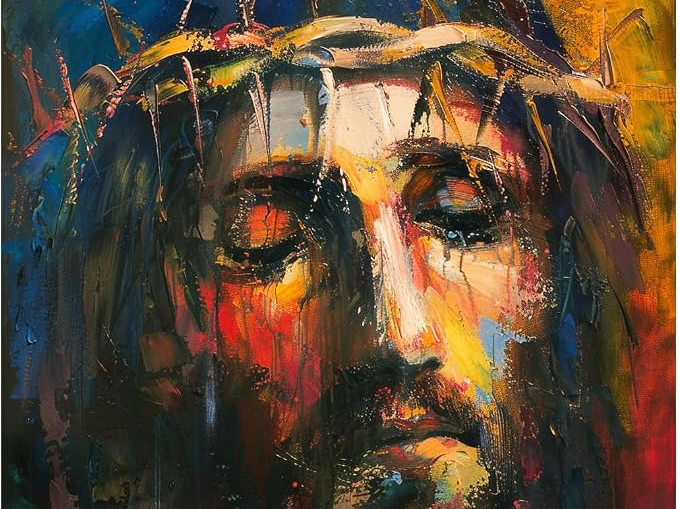
A reflection on the classic hymn, O the Deep, Deep Love of Jesus
Part 2
By Rod Benson
This article reflects on the second stanza of the hymn, which calls the Church to spread the praise of Jesus and celebrates his unchanging love, sacrificial death, continuing care and heavenly intercession.
The second stanza moves from the vastness of Jesus’s love to its constancy and personal attentiveness. Jesus is not simply a revered teacher whose earthly work ended long ago. The crucified Christ has been raised and enthroned, and remains actively involved with his people. His heavenly reign does not distance him from human need. It enables the Church in every place to confess that Christ loves, knows and represents his people as their priest in the glorious presence of the Father. Here are the words of stanza two:
O the deep, deep love of Jesus—
Spread His praise from shore to shore!
Praise His mercy, praise His goodness;
Praise His love forevermore.
How He watches o’er His loved ones,
Died to call them all His own;
How for them He intercedes,
Watches o’er them from His throne.
Love that does not change
The stanza emphasises the permanence of Christ’s love. Human love, even at its best, is vulnerable to exhaustion and inconsistency. Christ’s love arises from the covenant faithfulness of God. “Jesus Christ is the same yesterday and today and forever” (Heb 13:8). This constancy does not mean immobility or detachment. It means that his character and promises can be trusted.
John’s Gospel provides an important allusion. Having loved his own who were in the world, Jesus loved them “to the end” (Jn 13:1). The expression suggests both duration and completeness. That love is enacted when Jesus washes his disciples’ feet and reaches its decisive expression when he lays down his life and submits to crucifixion. The disciples are not an obviously deserving community: one betrays him, another denies him and the others flee. Christ’s steadfast love is not a reward for their achievement. It is grace that restores and transforms them.
This assurance does not result in casual discipleship. Grace gives Christians the security necessary for honest self-awareness and humble repentance. We can acknowledge failure without pretence or despair because the one who exposes sin is also the one who gives himself to redeem sinners such as us.
Dying to make us his own
The stanza connects Christ’s love with his death and with the creation of a people who belong to him. Paul tells the Corinthians, “You were bought with a price” (1 Cor 6:20), while Titus speaks of Christ giving himself to redeem and purify “a people of his own” (Tit 2:14).
Such language can be misunderstood if separated from its biblical setting. Christ does not possess people as an earthly master possesses property. He liberates them from enslaving powers so that they may enter the freedom of loving communion with God. To belong to Christ is to be released from the tyranny of sin, fear, status and self-justification. Christians are no longer enclosed within private desire; they have been claimed for love and summoned into service.
This belonging is personal and communal. Through his death Christ creates a reconciled people. The cross breaks down estrangement and forms a new humanity in which inherited hostility no longer possesses final authority (Eph 2:13-18). To confess that Christ has made us his own is to recognise others as members of the same beloved community.
Praise from shore to shore
The stanza’s missionary impulse follows from this communal belonging. Christ’s praise extends across geographical, cultural and ecclesial boundaries because his love cannot be confined to one nation or denomination. The Church does not own Christ or control access to grace. Mission is testimony to a love offered to the world.
Such testimony must not become triumphalist. The Church’s praise is credible when proclamation takes the form of humble service, reconciliation and solidarity. Christian mission contradicts its message when it becomes coercive, culturally arrogant or self-promoting. The love announced from shore to shore must be recognisable in the manner of its announcement.
This gives the stanza an ecumenical dimension. Churches confess the same Lord whose love exceeds their institutional boundaries. The call to spread Christ’s praise therefore summons Christians to common witness, mutual recognition and repentance for divisions that obscure the gospel.
Watched over by our Shepherd
The claim that Jesus watches over his people evokes the biblical image of the shepherd. In John 10 Jesus describes himself as the good shepherd who knows his sheep, calls them by name and lays down his life for them. The First Letter of Peter similarly names Christ as the Shepherd and guardian of the soul (1 Pet 2:25).
Christ’s watchfulness should not be imagined as divine surveillance. His gaze is not the suspicious scrutiny of an authority waiting for mistakes. It is the attentive regard of the shepherd who knows when one of the flock is lost, wounded or threatened. Psalm 121 offers a close parallel: the God who keeps Israel neither slumbers nor sleeps.
Christians nevertheless suffer illness, violence, injustice and death. His guardianship cannot mean that nothing painful will happen to those who trust him. The deeper promise is that suffering cannot cancel their belonging, sever them from his love or defeat God’s purpose for them. They are kept through suffering and, finally, beyond death.
Christ’s heavenly intercession
The stanza reaches its theological centre in the image of Jesus interceding from the throne. Paul asks who can condemn God’s people when Christ has died, has been raised, is at God’s right hand and intercedes for them (Rom 8:34). Hebrews declares that Christ always lives to make intercession for those who approach God through him (Heb 7:25).
Christ’s intercession does not mean that the Son must persuade a reluctant Father to become merciful. The sending of the Son already proceeds from the Father’s love. Father, Son and Spirit act together in salvation. The image means that the crucified and risen Jesus represents humanity within the communion of God. Our brother, who knows suffering and mortality from within, is also our great high priest.
This gives prayer its confidence. Christians do not approach God alone or depend upon the fluency of their prayers. Their prayer is gathered into Christ’s prayer. When they do not know how to pray, the Spirit intercedes within them while Christ represents them before the Father (Rom 8:26-27, 34).
The throne from which Jesus intercedes for us is also the throne from which he reigns. The Book of Revelation portrays the victorious Lord as a Lamb who was slain (Rev 5:5-10). Divine sovereignty is marvellously revealed as self-giving love. Those who are watched over by Christ learn to watch over the vulnerable among them; those represented by Christ learn to intercede for others. His constancy becomes visible when his people practise faithful, protective and reconciling love for one another, and for the world of people in their circle of influence.
Rev Dr Rod Benson is General Secretary of the NSW Ecumenical Council and a minister of the Uniting Church in Australia serving at North Rocks Community Church in Sydney.
Image source: Toperfect

