
By Rod Benson
If artists possess the freedom to address political questions, what responsibilities accompany that freedom? The dispute surrounding Macklemore’s removal from Ed Sheeran’s American tour illustrates why the answer cannot simply be that celebrities should speak whenever they possess strong convictions. Public platforms magnify both insight and error. The greater the audience, the greater the obligation to distinguish advocacy from simplification, moral urgency from propaganda, and compassion from selective identification.
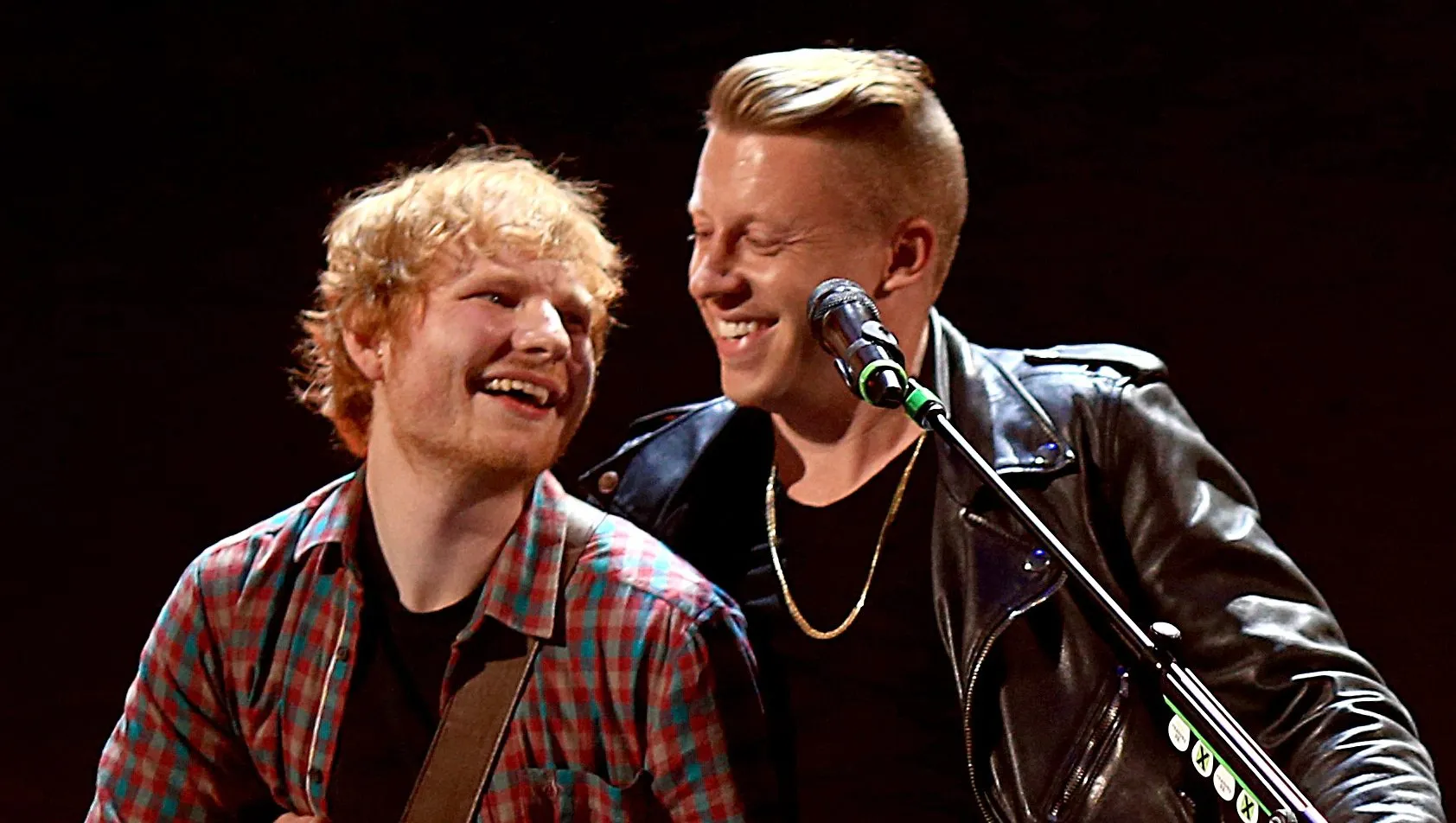
Macklemore has publicly advocated Palestinian rights for several years. During Sheeran’s MetLife Stadium concerts in September 2026, he told audiences that Palestinians in Gaza and the occupied West Bank had not been forgotten, declared “Free Palestine,” and performed Hind’s Hall accompanied by images from Gaza. Following objections from advocacy groups and stadium operators, Messina Touring Group announced that multiple forthcoming venues would refuse to stage concerts if Macklemore remained on the lineup. He was subsequently removed from the dates on which he had been scheduled to appear.
The episode demonstrates that freedom of speech and freedom from consequences are different principles. Macklemore remains entitled to advocate Palestinian freedom. Stadium owners remain entitled, within legal and contractual limits, to determine who appears at their properties. Audiences are entitled to criticise either decision. Yet describing those rights does not resolve the ethical issue, because formal rights can coexist with significant inequalities of power.
Speech requires responsibility
Celebrity does not create political expertise. A large audience can easily generate an impression of authority the speaker does not possess. Musicians intervening in wars, international law or complex historical conflicts should therefore accept responsibilities proportionate to the reach of their platforms: factual accuracy, intellectual humility, careful terminology and willingness to correct errors.
These obligations apply across ideological lines. Criticism of Israeli governments should not become hostility toward Jewish people. Hamas cannot properly be treated as representing Palestinians collectively. Jewish identity cannot be collapsed into Zionism, nor Palestinian identity into support for Hamas. Distinguishing states, governments, military forces, political organisations, religious communities and civilian populations is essential to responsible public argument.
At the same time, demands for perfect expertise should not become devices for excluding ordinary moral judgement. One does not require advanced academic expertise to recognise starvation, bereavement, displacement or civilian death as matters of moral concern. Expertise becomes indispensable when diagnosing causes, evaluating disputed evidence or proposing political solutions; elementary human solidarity begins earlier.
The problem of selectivity
A harder criticism concerns selective activism. Why Gaza rather than Sudan? Why Palestine rather than Ukraine? Why one injustice and not another? The question has force if an artist implies that only one suffering population deserves attention, but no individual can publicly advocate every worthy cause. Moral attention is inevitably selective because human attention is finite. The proper test is whether the principles invoked in one case would recognise the equal humanity of people elsewhere.
Universal human rights provide an important safeguard against tribal compassion. The rights of Palestinian children do not depend upon denying the suffering of Israeli children. The right of Jewish people to live without antisemitism does not depend upon denying Palestinian rights. Moral consistency requires holding these propositions together even when political discourse pressures people to choose between them.
The question is not whether public figures must adopt the same political conclusions, but whether the principles they invoke—human dignity, compassion, freedom and opposition to hatred—remain operative when applying them becomes costly, contested or institutionally inconvenient.
Macklemore’s own responsibilities
The strongest criticism of Macklemore is not that he expressed a political view but that he used a platform situated within another artist’s tour to advance a message that had not necessarily been anticipated by the headline artist, promoter or audience. Support acts participate in a relationship of trust and dependency. Their freedom to speak must therefore be considered alongside obligations arising from context, contract and shared responsibility for the event.
The available reporting does not appear to reveal the full contractual arrangements governing Macklemore’s appearances. That uncertainty prevents confident conclusions about whether he breached any formal understanding. Ethically, however, the issue remains. Conscience is not a licence to disregard the legitimate expectations created by collaboration.
Yet neither is collaboration a licence for enforced silence. The relevant question is whether his intervention remained within the bounds of legitimate moral and political advocacy or crossed into conduct that substantially altered the character of an event without sufficient regard for others. His explicit distinction between criticism of Israeli policy and hostility toward Jewish people should form part of that assessment.
Sheeran and the limits of neutrality
Ed Sheeran’s position deserves similarly careful analysis. Macklemore said the two had engaged in difficult conversations and described Sheeran as a close friend placed in an unusually difficult position. Sheeran subsequently stated that he had attempted to mediate between venue owners, promoters and activists but that the promoter and venues made the final decision. He also argued that cancelling stadium concerts would have consequences for ticket holders, touring crews, musicians and support staff who depended on the tour for employment.
This complicates accounts portraying Sheeran as the sole agent. Preserving the tour affected many people besides the headline performer. Yet neutrality also has limits. Once powerful third parties condition access to major venues upon excluding a performer because of controversial political expression, continuing the tour is not an entirely apolitical act. The surrounding institutional environment has already become political.
Sheeran himself offered a different understanding of his stance. He described his platform as a place of safety, diplomacy and cultural connection and rejected the suggestion that declining to state every political view publicly amounted to indifference. That position deserves engagement on its own terms. Political reticence is not necessarily moral indifference, although it does not remove the ethical consequences of decisions made within an already politicised environment.
P!NK, fear and mutual recognition
P!NK illustrates another complexity. She amplified criticism of Macklemore but later clarified that she did not object to the phrase “Free Palestine,” did not want him fired and was not advocating the silencing of artists. Speaking as a Jewish mother, she said aspects of his presentation frightened her and people she loved. Her clarification should be taken seriously. Jewish anxiety about antisemitism cannot simply be dismissed because other observers interpret the same speech differently.
Recognition, however, should operate reciprocally. Palestinians and those identifying closely with their suffering may hear demands for moderated language or silence as pressure to make devastating human suffering less visible. The ethical challenge is not to decide which community possesses the more legitimate fear but to sustain moral discourse capable of recognising both without allowing either to erase the other.
When values become branding
There is nevertheless an unavoidable question for artists whose work repeatedly celebrates empathy, kindness, love or social transformation. Audiences do not necessarily hear such themes as aesthetic decoration. Over time they become associated with an artist’s public identity and therefore create expectations about how those professed values function outside the recording studio.
Every song about kindness, empathy, love or changing the world may eventually be heard against what the singer did when such ideals encountered a costly test. This is not an argument that musicians must adopt a prescribed political position. Nor does inconsistency automatically prove personal hypocrisy. Human beings frequently hold values sincerely while failing to apply them consistently under pressure.
The more defensible criticism concerns moral coherence. Values repeatedly presented as serious invite audiences to ask how they operate when maintaining them entails professional, commercial or reputational costs. At some point beautiful words risk sounding less like principles and more like branding if a persistent gulf develops between the virtues publicly celebrated and the risks an artist is prepared to bear.
Such criticism should be made cautiously. Large tours sustain many livelihoods, factual disputes can be complex, and prudence is not synonymous with cowardice. Yet songs about compassion and public philanthropy should not insulate artists from scrutiny when difficult cases arise.
Macklemore’s position is unusually explicit in this respect. He said before losing his tour place that personal comfort was not worth silence and later accepted removal as a consequence of speaking according to conscience. His willingness to bear professional loss does not establish the correctness of everything he says, but it makes the relationship between conviction and cost unusually visible.
Private power and cultural freedom
American entrepreneur Robert Kraft presents the converse case. He argued that permitting Macklemore to perform at Gillette Stadium would conflict with responsibilities toward the Jewish community, citing what he regarded as a history of offensive rhetoric and imagery. Such reasoning deserves more serious engagement than simply labelling it censorship. Owners have legitimate responsibilities toward patrons and may establish boundaries around conduct at their venues.
The difficulty lies in distinguishing speech that causes offence from speech that constitutes hatred, and in applying such distinctions consistently. More fundamentally, it is necessary to distinguish legal freedom of speech from cultural freedom. Private stadium owners are generally not bound by constitutional free-speech requirements in the same way as governments. Their legal entitlement to exclude performers may therefore be clear.
Yet private control over major cultural infrastructure can still have public consequences. When only a small number of venues can accommodate national-scale stadium tours, decisions by those owners can shape what kinds of political expression remain compatible with access to mass audiences. Lawfulness does not settle the ethical question. Concentrated private power may merit scrutiny precisely because it is powerful.
The intervention by U.S politician Alexandria Ocasio-Cortez drew attention to this point. Her description of the episode as an abuse of power is a political judgement rather than an established legal conclusion. Nevertheless, the underlying issue is significant: how should private power be exercised when control of cultural infrastructure gives a small group of owners unusual influence over public expression?
The withdrawal of the other supporting artists made the dispute more significant still. Finneas, Aaron Rowe, Beoga and Lukas Graham independently withdrew from forthcoming performances, explicitly citing Palestinian suffering, artistic freedom or objections to venue owners controlling political expression. Their decisions did not establish that Macklemore was correct. They did show that other artists were willing to bear professional costs in response to the same controversy.
Keeping the human stakes in view
There is a danger, however, that the controversy becomes absorbed into questions of celebrity courage, artistic freedom and reputational damage while the people suffering most disappear from view. Macklemore, Sheeran, P!NK and Kraft retain extraordinary levels of wealth, public access and institutional protection. The civilians affected by war do not.
That asymmetry should discipline the argument. The controversy matters not because the professional discomfort of musicians is morally equivalent to death, hunger, bereavement or displacement. It matters because debates about celebrity platforms can either illuminate or obscure those realities.
How would Jesus respond?
A Christian reading should begin not by determining which celebrity deserves vindication but by asking what habits of moral perception the Gospels cultivate. Jesus repeatedly directs attention toward people whose suffering respectable society would prefer not to see. He crosses inherited social boundaries, attends to the marginalised and refuses to reduce persons to political or religious categories.
Jesus also challenges selective compassion. The Samaritan becomes exemplary not because he belongs to the correct constituency but because he recognises suffering and acts. The command to love enemies is more demanding still: compassion cannot be reserved for those whose identity, politics or history make sympathy easy.
Yet Jesus’ compassion is never detached from truth. He confronts hypocrisy, names exploitation and challenges abuses of authority. Compassion without truth becomes sentimentality; truth without compassion can become cruelty. The Christian task is therefore to hold together accurate judgement, solidarity with sufferers and scrutiny of power.
That principle destabilises every attempt to turn this conflict into a competition of suffering. Jewish fear cannot simply be dismissed; Palestinian suffering cannot simply be subordinated to geopolitical convenience. Christian discipleship calls for forms of solidarity sufficiently capacious to acknowledge both while remaining prepared to name injustice where evidence warrants it.
A plural democratic society will not achieve unanimity on Israel, Palestine, Zionism, antisemitism or the legal characterisation of military conduct. Its health depends instead upon the quality of disagreement. Public culture requires practices that allow serious moral conflict without dehumanisation: respect for universal rights, evidential care, intellectual humility, freedom of conscience and restraint in the exercise of institutional power.
Artists who speak politically therefore incur real responsibilities, but so do those who control their access to audiences. Public speech should be accurate, proportionate and humane. Private cultural power should be transparent and consistently exercised. Audiences should resist treating compassion as a finite commodity distributed only to those on their own side. For Christian ethics, the key question is not merely who has permission to speak, but whether moral goods such as freedom, responsibility and human dignity can be held together when doing so becomes costly.
Rod Benson lives in Sydney and writes about a range of topics from books and local history to food, faith, philosophy, ethics, research skills, and everyday life. Away from the keyboard, he enjoys cooking for friends, walking in the Australian bush, exploring a beach, discovering new restaurants, and reading philosophy, fiction and poetry. He is married to Emma.
Image source: Hollywood Life

