
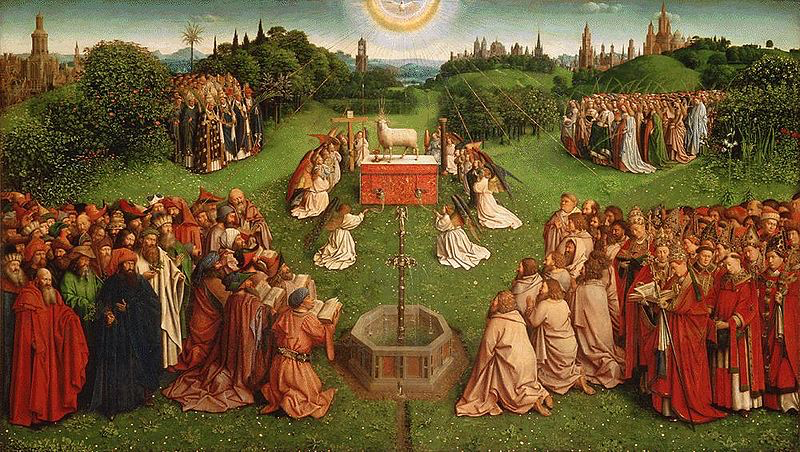
In the early chapters of the Book of Genesis, there are four rivers. Two are unknown to us today; the others are the Tigris and the Euphrates, flowing through present-day Iraq.
At the end of the Bible’s narrative arc, there is also a river. John writes that he sees “the river of the water of life, clear as crystal, flowing from the throne of God and of the Lamb” (Rev 22:1). Beside it stands the tree of life, bearing fruit, while its leaves are “for the healing of the nations” (Rev 22:2).
The Book of Revelation intentionally echoes the river vision of Ezekiel 47 and also draws upon the tree of life in Genesis. River, tree, fruit and healing are gathered into the final biblical vision of peace, harmony and community. This is a beautiful image expressing the reality of Christian hope.
Not escape, but renewal
Christianity is sometimes imagined as a religion of escape in which the earth deteriorates while redeemed souls depart for heaven. Revelation offers a more complex vision. John sees a new heaven and a new earth, a city, nations, water and trees. Most importantly, he hears the declaration that God will dwell among us. Our goal is not an endless ghostly existence in some kind of otherworld, but an eternal material existence in community within a renewed and transformed terrestrial paradise.
But wait: after his resurrection, did Jesus not ascend into heaven from Mt Olivet, and clouds obscure him from view? The cloud can be read as a veil of divine presence rather than a trap door in the sky. That reading has strong biblical support, although Acts does describes a real departure. The disciples see Jesus “taken up,” then the cloud removes him from their sight (Ac 1:9). Luke presents a change in how the risen Jesus is present and exercises his authority.
English New Testament scholar N. T. Wright gives the clearest account of this idea. For him, heaven and earth are distinct but overlapping and interlocking dimensions of God’s creation. Heaven is not a remote address somewhere deep within the physical universe, nor is it a location outside the universe.
Wright reads the ascension of Jesus in Acts 1, and the miracle of Pentecost in Acts 2, together: Jesus, in his human body, is taken into heaven, and the Holy Spirit makes the life of heaven active on earth. That retains the significance of Jesus’ bodily resurrection while resisting a strict division between material earth and spiritual heaven.
In a similar way, the Christian philosopher Dallas Willard approaches the question through the nearness of God’s kingdom. In The Divine Conspiracy, he challenges the habit of locating God and heaven far away, accessible only after death. God acts in the world around us, and life under God’s rule is available now. His emphasis helps explain why Jesus’ departure from sight need not mean that his reign is from some other “dimension.”
The text holds together distinction and connection: Jesus is taken from the disciples’ sight and exalted to God’s presence; the Spirit comes to them; and they are sent by the Spirit as witnesses “to the ends of the earth” (Ac 1:8). The question of the angels to those astonished disciples, “Why do you stand looking up toward heaven?” (Ac 1:11a) turns their attention from prolonged sky-gazing to their earthly vocation of serving as Jesus’ “witnesses … to the ends of the earth” (Ac 1:8).
So the grand biblical narrative of Genesis to Revelation is not simply humanity escaping creation. It is God dwelling with creation renewed. The conclusion to the Book of Revelation does not provide a scientific description of the future. It is apocalyptic literature rich in symbol, which is why it is so hard for us to understand on an initial or surface reading.
Ecological responsibility
Yet its theological direction is clear: the material creation is far from irrelevant to God’s final purposes. The poet Malcolm Guite beautifully captures something of this integration of God’s ongoing purpose for this world in his poem titled “Ascension” when he says,
As earth became a part of Heaven’s story
And heaven opened to his human face[1]
Guite names the paradox of the departure of Jesus becoming a new, universal presence, with his divine glory simultaneously revealed and concealed. He also helps us to see that Christian redemption does not require the dismissal of embodied creation, but locates this world profoundly within the reconciling purposes of God in Jesus Christ.
That gives ecological responsibility a place within Christian hope. We do not care for the world because we imagine human beings can create the kingdom of God. We care because the world belongs within a grace-filled future that God has promised.
Yet Christian hope is more than biological survival or ecological recovery. Revelation’s vision reaches beyond healthy ecosystems to communion with God, the removal of the curse, the healing of the nations and life in the presence of the Lamb. Ecological life belongs within that hope, but it does not exhaust it.
Hope is not denial
The continent on which we live experiences highly variable rainfall, increasing heat and significant changes in some regional rainfall patterns, alongside familiar exposure to drought, fire and flood. We should not use the idea of Christian hope to minimise such realities. Hope is not denial, but neither is hope the same as optimism. Optimism assumes that circumstances will probably improve; Christian hope rests upon the faithfulness of God.
The resurrection of Jesus gives that hope its shape. Christianity takes death seriously but refuses to grant death the final word. The same pattern applies to ecological discipleship. We do not pretend every loss can be reversed, nor do we conclude that faithful action is meaningless. Hope frees us to take responsible action without believing—or feeling—that everything depends upon us.
The resurrection also reminds us that Christian hope cannot be reduced to ecological recovery. Even a flourishing ecosystem remains part of mortal creation. The gospel of Jesus promises more than improved environmental conditions. It promises resurrection, reconciliation and life with God through Jesus Christ.
We should work for cleaner rivers, healthier habitats and resilient communities, but none of these should be asked to carry the weight of eternal salvation. Jesus alone bears, and bore, that weight for us.
A foretaste of renewal
The Uniting Church’s Basis of Union gives especially helpful language here. It describes the Holy Spirit as a “pledge and foretaste” of the coming reconciliation and renewal whose end is the whole creation, and describes the Church as a pilgrim people moving towards a promised goal. A foretaste is not the whole reality, but it gives some experience of what is promised.
That is a useful way to understand our responsibility to participate in ecological action. A native garden does not restore the world’s biodiversity, but it can give life to one place.
A restored creek does not heal the whole creation, but it can become healthier than it was. Solar panels do not reverse climate change, but they can express responsible use of resources. Helping neighbours during extreme heat does not eliminate ecological risk, but it embodies solidarity.
On the other hand, as I have observed in all of these sermons on the Season of Creation, it is possible for all of us to become passionate about ecological sustainability while remaining spiritually thirsty. We may help restore a river and still neglect the river of life that flows from God. We may devote ourselves to sustaining physical life while forgetting that Jesus speaks of life in a deeper and more enduring sense.
The ecology of the spirit also requires attention. Prayer, repentance, worship, Scripture, fellowship, forgiveness and communion with Christ are not alternatives to ecological responsibility. They belong to the life by which Christian responsibility is sustained.
John’s river flows from the throne of God and of the Lamb. The source is always divine grace. The river does not begin with us, and the future does not depend upon us, but we are invited by God to live beside the river, drink from it, and allow its life to shape the way we inhabit God’s world.
Hope does not excuse us from action. It frees us for faithful action. As we care for the ecology of the earth, let us not neglect the ecology of the spirit and the abundant life God offers through salvation in Jesus Christ.
Sermon 873 copyright © 2026 Rod Benson. Preached at North Rocks Community Church, Sydney, Australia, on Sunday 27 September 2026. Unless otherwise noted, Scripture quotations are from The Christian Standard Bible (Nashville: Holman Bible Publishers, 2020).
Rev Dr Rod Benson is General Secretary of the NSW Ecumenical Council and a minister of the Uniting Church in Australia serving at North Rocks Community Church in Sydney.
Reference
[1] Malcolm Guite, “Ascension,” in Sounding the Seasons: Seventy Sonnets for the Christian Year (Norwich: Canterbury Press, 2012).
Image source: Year in the Bible
Taking it further….
Reflection questions
- The sermon presents God’s promised future as the renewal of creation. How does this challenge or enrich your understanding of heaven and eternal life?
- How does the sermon’s account of Jesus’ ascension and the coming of the Holy Spirit connect Jesus’ reign with our earthly vocation?
- How does the description of the Holy Spirit as a “pledge and foretaste” of coming renewal help explain both the value and the limits of ecological action?
Application questions
- How might trusting in God’s faithfulness help you care for creation without becoming overwhelmed by the scale of the task?
- Which practices nourish your “ecology of the spirit,” and which have you neglected? How could you connect one of these practices with your care for creation this week?
- How could your congregation make care for creation a continuing expression of worship, discipleship and witness? What first step could you take together, and when would you review it?

