
How many of us read books by Enid Blyton as a child? I’m thinking especially of her “Famous Five” series, and “Secret Seven” series, but there were hundreds more.
Blyton also wrote adaptations of biblical stories for children. The Man Who Stopped to Help was first published in 1965, with illustrations by Elsie Walker, and reissued in 1976 alongside The Boy with the Loaves and Fishes.
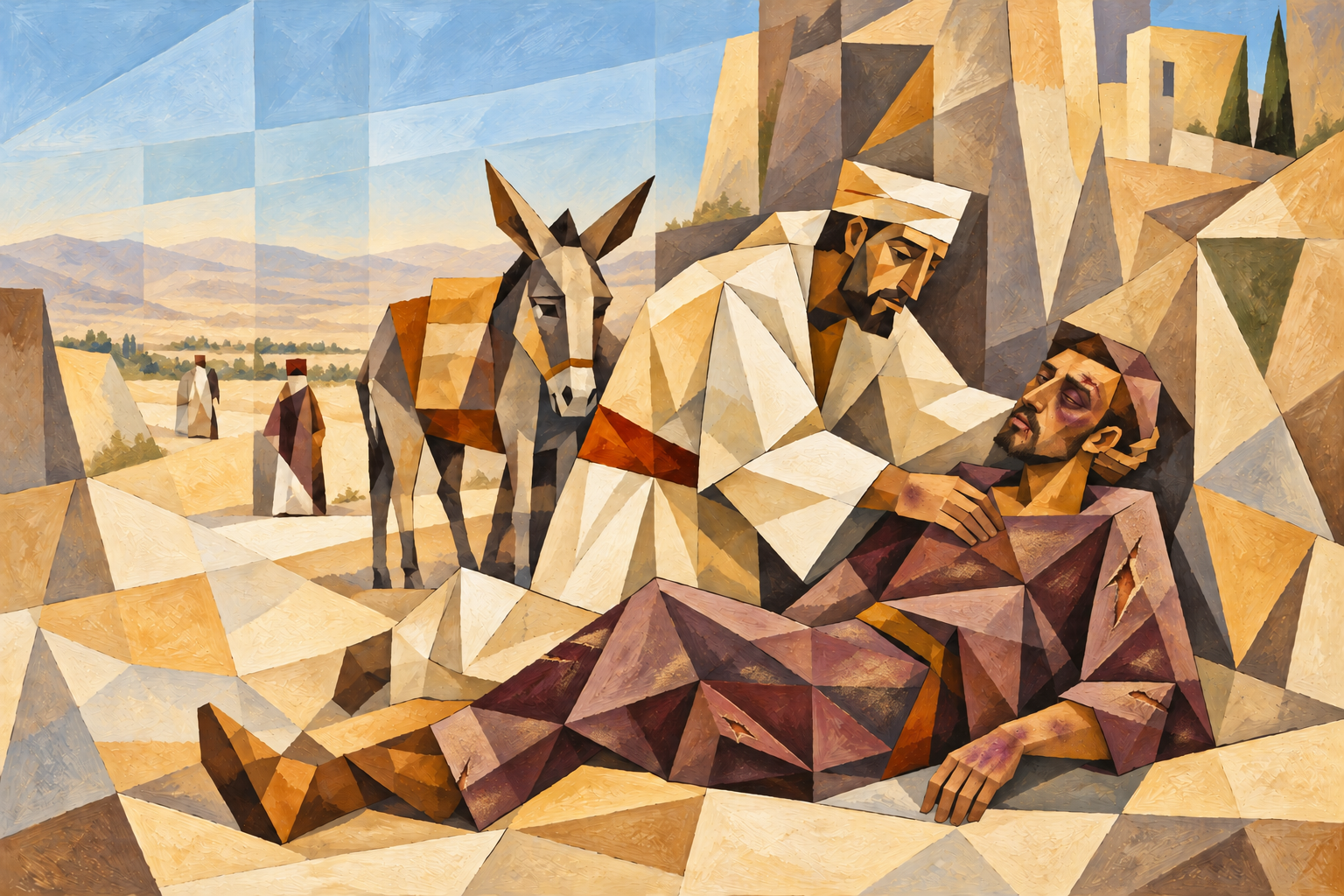
The Man Who Stopped to Help retells the famous Parable of the Good Samaritan from Luke 10 for children. A traveller is robbed, beaten and abandoned. A priest and a Levite pass by without rendering assistance, but a Samaritan stops and tends his wounds, then arranges accommodation and ongoinging care. The story presents neighbourly love as practical compassion across social and religious boundaries, inviting young readers to recognise need, overcome prejudice and offer generous help.
It’s a story for adults too. Today, I want to reflect on this parable through the lens of social cohesion, a term that has come to prominence in Australian political rhetoric amid instances of alleged antisemitism, Islamophobia and other community tensions.
Social cohesion is a set of ethical practices guided by policy emphasising security, belonging, trust and shared civic responsibility.
It’s not quite the same as multiculturalism. The Uniting Church declared in 1985 that it is intentionally a “multicultural” Church, and there are various ways in which we can measure the extent to which we measure up to our high ideal. But that is not the same as declaring that the Uniting Church is a socially cohesive Church.
Multiculturalism recognises cultural diversity and supports equal participation without requiring people to abandon their heritage. Social cohesion concerns the quality of the relationships that hold a society together, including relationships extending across political, economic and religious divisions.
The concepts do overlap: for example, an inclusive embrace of multiculturalism has the capacity to strengthen social cohesion. But social cohesion becomes problematic when it is interpreted as conformity to a certain set of social norms, or when it discourages legitimate dissent, or when it has the effect of obscuring the reality of racism and inequality in our community.
The crucial question is whether a government is willing to pursue unity through equitable participation and mutual respect, or instead demands harmony without addressing the underlying injustice that, if left unchecked, will poison multiculturalism and destroy social cohesion. There’s more to social cohesion than shared identity or peaceful coexistence. It requires people to recognise obligations toward those beyond their familiar circle of influence.
The brilliant parable in Luke 10:25–35 offers a theological account of this responsibility. Although social cohesion is a contemporary concept, the passage illuminates how a community becomes capable of sustaining life across contested boundaries of belonging.
The encounter begins when a Jewish lawyer asks Jesus how he might inherit eternal life. Jesus directs him to Scripture, and the lawyer observes the imperative of loving God and loving one’s neighbour.
Jesus affirms the lawyer’s answer. He has excelled. These biblical commands establish a solid foundation for life in community. The challenge is making that responsibility practical, moving from doctrine to ethics, from theory to praxis.
The lawyer asks a further question: “Who is my neighbour?” This raises an issue central to social cohesion. The communities in which we participate develop identities and boundaries over time, but these can be manipulated to restrict concern and limit goodwill.
In the parable, the lawyer is not really interested in Jesus’s answer to his second question. He wants a response that justifies the status quo, that justifies his unwillingness to extend his concept of neighbour to include a Samaritan. It’s a step too far.
For his part, Jesus exposes the inadequacy of an ethic that is preoccupied with determining the limits of personal responsibility rather than pursuing social cohesion, justice, and shalom.
What of the wounded traveller? We are not told his ethnicity, religion or social standing. None of that matters. He is a vulnerable person in need, without family or friends—until the Samaritan comes along. His anonymity challenges social arrangements that make assistance depend on recognised membership.
By contrast, a cohesive society enables strangers, empowers minorities, and lifts people who have no influence, helping them receive the protection and care and opportunity they need.
The priest and the Levite see the injured man but pass by. Their motives are unstated. What matters is the gap between recognised religious standing and the desire to do the right thing. The Samaritan does what they seem unable or unwilling to do. His compassion crosses a boundary of religious and communal difference. His actions suggest that social trust can emerge through encounters in which inherited suspicions lose their governing power.
Jesus makes the unexpected “outsider” an exemplary agent of care, challenging his listeners to recognise moral agency beyond their own community, in unexpected contexts. The Samaritan treats the injured man’s wounds, provides transport, secures accommodation and funds his continuing care. It is an extraordinary outpouring of thoughtful love and compassion.
Social cohesion likewise requires practices and institutions that carry responsibility beyond momentary sympathy and bursts of emotion. It involves allocating resources, sharing burdens and ensuring that vulnerable people are not abandoned after the initial crisis.
Verses 36–37 complete the argument by asking who became a neighbour to the injured man. Applied to social cohesion, this shifts attention from belonging as a qualification for care to care as a practice that creates belonging.
Every community grows stronger when mercy crosses the road in response to a need, and is transformed into dependable mutual responsibility.
The first Christians understood this well. In Acts 2, they created an amazing community that was at once multicultural and committed to social cohesion. Soon after, Paul wrote that “those of you who were baptised into Christ have been clothed with Christ. There is no Jew or Greek, slave or free, male and female; since you are all one in Christ Jesus” (Gal 3:26-28). The seeds of social cohesion were beginning to bear fruit.
The National Council of Churches in Australia recently released a statement and policy on social cohesion that pairs very well with today’s text and reflection. The Council identifies three dimensions of social cohesion: belonging, bonding and bridging.
Together, they illuminate the challenge Jesus places before us. We nurture belonging when people know they are loved and respected. We strengthen bonds through dependable care for those in need. And we build bridges when compassion carries us beyond the boundaries of our own community.
That is what the Samaritan does. He recognises a stranger’s suffering, crosses the distance between them, and commits himself to the man’s recovery—at significant personal expense and inconvenience. Jesus makes this outsider our teacher: someone from whom we must learn what love of neighbour means.
The NCCA statement and policy invite us to embody that mercy in our common life, building trust through our principled pursuit of justice, welcoming outsiders in, and rendering practical service to those in need.
Whose suffering will we notice? What boundary will we cross this week? What small act of care will we pursue? Jesus leaves us with a calling that is both simple and demanding: “Go and do likewise.”
Let us begin.
Sermon 875 copyright © 2026 Rod Benson. Preached at North Rocks Community Church, Sydney, Australia, on Sunday 11 October 2026. Unless otherwise noted, Scripture quotations are from The Christian Standard Bible (Nashville: Holman Bible Publishers, 2020).
Rev Dr Rod Benson is General Secretary of the NSW Ecumenical Council and a minister of the Uniting Church in Australia serving at North Rocks Community Church in Sydney.
Image source: author
Taking it further….
Reflection questions
- How does Jesus shift the lawyer’s question from “Who is my neighbour?” to asking what it means to become a neighbour?
- What does the Samaritan’s role as an outsider challenge us to reconsider about who can teach us to love well?
- How does the Samaritan’s provision for continuing care deepen our understanding of compassion and shared responsibility?
Application questions
- How could your congregation turn an occasional act of assistance into dependable, ongoing care? What resources and commitments would this require?
- Where might racism, inequality or pressure to conform be weakening relationships in your community? How could you challenge this while fostering mutual respect?
- What shared activity could your congregation undertake with another cultural or faith community to meet a local need? Who will take the first step, and when?

