
The life and legacy of Father Eugene Stockton (1934-2026)
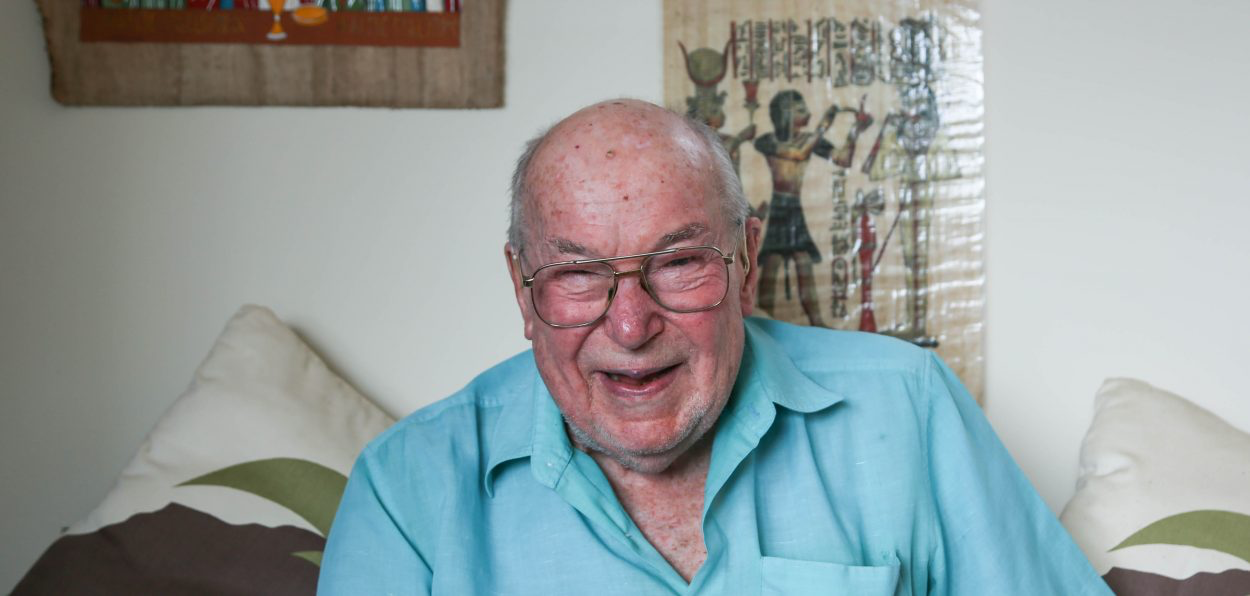
I am almost certain that no Australian Christian scholar has combined archaeology, anthropology, biblical studies, theology, and spirituality as fruitfully as Father Eugene Stockton, who died today.
Over more than six decades he explored what it means to follow Jesus faithfully in this ancient land of Australia. His work made significant contributions to Australian archaeology while helping shape conversations about Indigenous Australia, environmental responsibility, contextual theology, and Christian spirituality. Stockton is widely respected as an original and thoughtful voice whose scholarship continues to reward careful attention.
A scholar formed by two worlds
Born in 1934, Stockton was ordained to the Catholic priesthood in Sydney in 1958 by Cardinal Norman Gilroy. He later became a priest of the Diocese of Parramatta following its establishment in 1986. He pursued advanced studies in theology, Scripture, and archaeology in Sydney, Rome, and Jerusalem, undertaking biblical studies at the Pontifical Biblical Institute in Rome and archaeological and biblical studies in Jerusalem. These years provided him with a strong grounding in biblical history and the methods of Near Eastern archaeology.
Stockton returned to Australia convinced that this continent possessed its own ancient history deserving equally serious scholarly attention. Australia, too, contained sacred places, deep historical memory, and cultures extending back tens of thousands of years. If archaeology could illuminate the world of the Bible, it could also deepen Australians’ understanding of their own land and of the First Peoples who had cared for it across countless generations.
He became an important contributor to Australian prehistoric archaeology through excavations in the Blue Mountains and western Sydney, including work at Kings Tableland, Cranebrook Terrace, and other Aboriginal occupation sites. His research formed part of a broader body of archaeological scholarship that has transformed understanding of Aboriginal occupation in south-eastern Australia.
Through careful excavation, analysis of stone artefacts, and collaboration with advances in archaeological dating, Stockton contributed to evidence demonstrating the great antiquity and continuity of Aboriginal occupation. His work helped deepen scholarly appreciation of the richness, complexity, and resilience of Indigenous cultures long before European settlement. The significance of this research extends well beyond archaeology itself. By documenting Australia’s deep human history, Stockton helped reinforce a growing recognition that European settlement represents only a recent chapter in the story of this continent. His scholarship encouraged greater historical honesty and a deeper appreciation of Aboriginal cultural heritage.
For Stockton, archaeology was never simply about cataloguing artefacts or refining chronologies. Material remains point beyond themselves to questions of identity, memory, belonging, and meaning. Archaeology becomes an exercise in recovering human stories, enabling contemporary societies to understand both their inheritance and their responsibilities.
An interdisciplinary scholar
One of Stockton’s distinctive academic contributions lies in his interdisciplinary method. He consistently refused to isolate archaeology from theology, anthropology from spirituality, or history from ethics. Instead, each discipline illuminated the others. His archaeological research informed his theology of creation and place. Anthropological study deepened his engagement with Indigenous cultures and spirituality. Biblical scholarship provided theological frameworks through which these insights could be interpreted. Spiritual theology reminded readers that scholarship ultimately serves wisdom rather than the accumulation of information.
Such an approach has become increasingly familiar within universities, but Stockton demonstrated its value within Australian theological scholarship. His work consistently illustrates that the deepest human questions rarely fit neatly within disciplinary boundaries.
Perhaps Stockton’s most distinctive theological contribution has been his sustained search for an authentically Australian expression of Christian theology.
Christian theology has always taken shape within particular cultural settings. The gospel first found expression within Jewish culture before engaging Greek philosophy, Roman institutions, African Christianity, Celtic spirituality, and countless other traditions. Stockton argued that Australian Christians should likewise reflect seriously on how the historic faith is lived within Australia’s unique history, landscape, and cultural experience.
This did not mean constructing a new Christianity or abandoning orthodox doctrine. Rather, it meant allowing Australia’s physical environment and historical experience to become genuine contexts for theological reflection.
In this respect Stockton belongs within a broader movement of Australian theologians exploring contextual theology. His distinctive emphasis was the conviction that Australia’s ancient landscape and Indigenous cultures should occupy a central rather than peripheral place within that conversation.
Aboriginal spirituality and a theology of place
Long before reconciliation became a major focus of Australian public life, Stockton argued that Christians should engage respectfully with traditional Aboriginal spirituality. He took the view that Indigenous understandings of country, kinship, creation, community, and sacred presence offer valuable insights that can enrich Christian reflection while respecting the integrity of both traditions.
He observed significant points of resonance. Both traditions understand human beings as belonging within a created order rather than standing over it. Both recognise that land possesses moral and spiritual significance beyond economic value. Both understand identity in relational rather than purely individual terms.
Christian faith finds its centre in the person and work of Jesus Christ. Stockton nevertheless believed that respectful dialogue enables Christians to recover dimensions of creation, stewardship, and belonging that have sometimes received insufficient attention within Western theology. His work developed alongside, and contributed to, wider conversations that would later become prominent within contextual, Indigenous, and ecological theology.
Modern societies often regard land primarily as property or economic resource. Stockton invites people of faith to recover a more biblical understanding in which land is received as gift, entrusted to human care rather than absolute possession. Humans belong to places before they own them.
This perspective has become increasingly relevant as churches engage questions of environmental stewardship, biodiversity, climate change, and Indigenous justice. Stockton approached these issues principally through theological rather than political categories. His vision is fundamentally sacramental. Creation bears witness to its Creator, inviting gratitude, humility, and wonder. Caring for the natural world therefore becomes not merely an environmental responsibility but an expression of faithful discipleship.
Wonder and contemplation
Wonder is one of Stockton’s defining theological themes. Books such as Wonder, Landmarks, The Aboriginal Gift, and The Deep Within encourage readers to cultivate attentive receptivity before analysis. Genuine understanding begins not with mastery but with openness to reality as gift. For Stockton, knowledge is not simply intellectual achievement but participation in truth through reverent attention to God, creation, and neighbour.
His decision in 2001 to embrace the vocation of a diocesan hermit in the Blue Mountains reflects these convictions. The life of prayer, silence, and simplicity that followed represents a continuation rather than a departure from the themes that shaped his scholarship throughout his ministry.
An enduring legacy
Father Eugene Stockton’s influence has generally been exercised through scholarship, teaching, pastoral ministry, retreats, and published works rather than through public prominence. Nevertheless, his contribution has been substantial. He has encouraged generations of Australian Christians to think more deeply about the relationship between faith, place, history, creation, and Indigenous cultures.
Many of the questions now occupying Australian churches—including reconciliation with First Nations peoples, ecological responsibility, contextual theology, and the search for an authentically Australian Christian identity—were explored in Stockton’s work long before they became widespread concerns. While some of his conclusions remain open to debate, the questions he raised have proved both enduring and significant.
His scholarship demonstrates that rigorous historical research, archaeological investigation, theological reflection, and contemplative spirituality can enrich one another. Rather than treating these disciplines as separate pursuits, he showed how they together contribute to a richer understanding of Christian faith.
Father Eugene Stockton continues to invite Australians to read both Scripture and the land with humility, attentiveness, and gratitude, recognising that the ancient Christian faith can take deep and authentic root within Australia’s equally ancient landscapes. His remarkable interdisciplinary work stands as one of the most thoughtful and sustained attempts to articulate a genuinely Australian Christian imagination.
Rev Dr Rod Benson is General Secretary of the NSW Ecumenical Council and a minister of the Uniting Church in Australia serving at North Rocks Community Church in Sydney.
Image source: Catholic Outlook

