
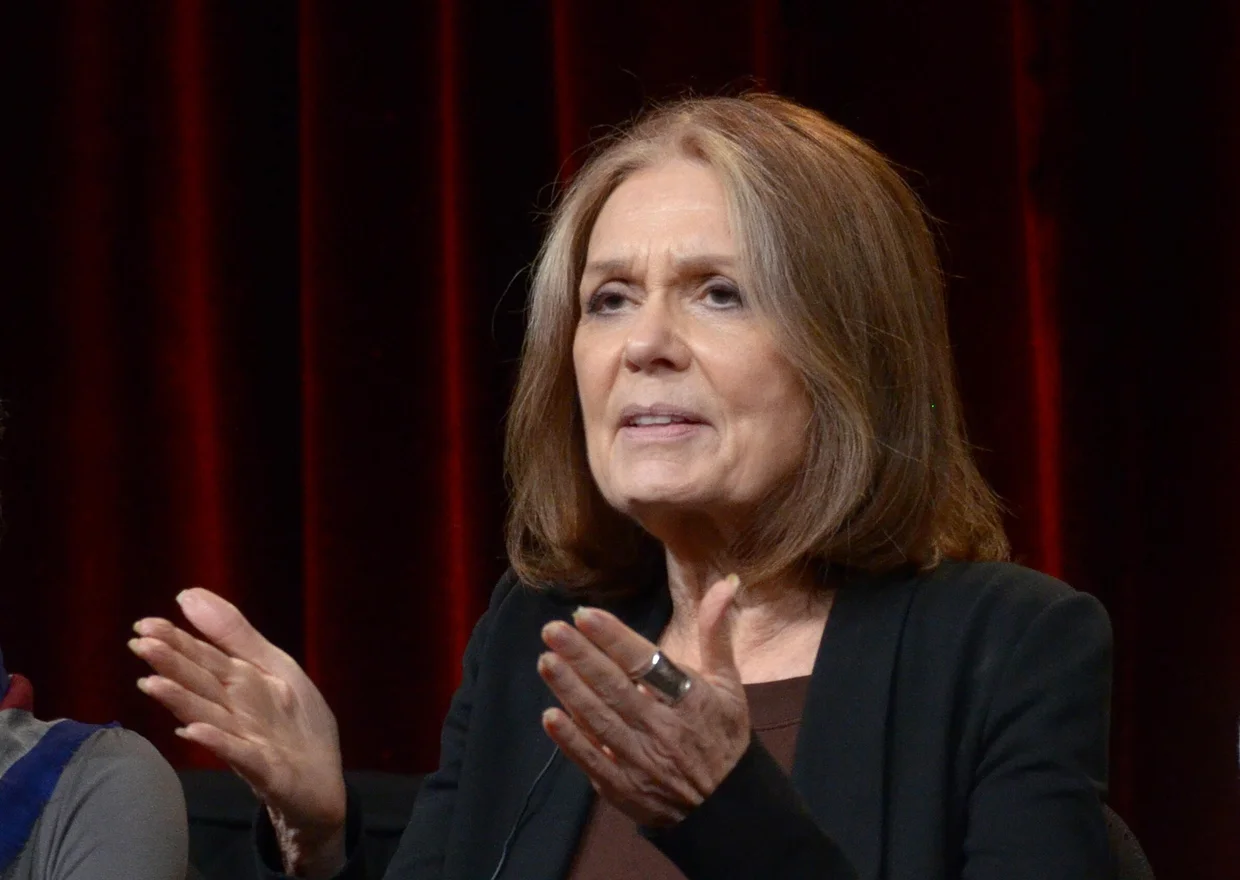
A reflection on the legacy of Gloria Steinem
By Rod Benson
As a man, and as a Christian, I admired Gloria Steinem from a distance as one of the most influential feminist writers, organisers and public intellectuals of the modern era. From the 1960s onward, she helped shape debates about women’s equality, political participation, sexual autonomy, workplace discrimination, domestic violence and the cultural construction of gender. She was also a gifted journalist and institution-builder whose influence extended far beyond the United States.
To understand Steinem’s work is to understand something of how second-wave feminism transformed public life, challenged inherited structures of authority, and reshaped the moral vocabulary through which gender, power, dignity and freedom are still debated.
Her death on 2 September 2026, aged 92, closes an extraordinary chapter in modern feminism. Steinem became one of the most recognisable public faces of the American women’s movement from the late 1960s onwards. She co-founded Ms. magazine, helped establish the National Women’s Political Caucus, campaigned for the Equal Rights Amendment, and remained an advocate for women’s political, economic and reproductive freedom for more than half a century.
Her importance, however, extends beyond particular reforms. She helped alter the way millions understood power: where it operates, whose experiences count, how institutions distribute authority, and how apparently private arrangements may embody political assumptions.
More than a feminist celebrity
Her prominence should not obscure the collective character of the movement. Feminism’s achievements depended upon a vast network of writers, organisers, lawyers, politicians and activists, including Bella Abzug, Shirley Chisholm, Dorothy Pitman Hughes, Flo Kennedy and many Black, lesbian and working-class feminists whose experience sometimes challenged mainstream priorities. Steinem’s particular gifts lay less in systematic theory than in communication, organisation and connection. She was an unusually effective public intellectual: someone able to translate ideas into accessible language, connect people and organisations, and build institutions capable of carrying feminist arguments into mainstream democratic culture.
That distinction is important in assessing her intellectual stature. Steinem’s originality did not lie chiefly in constructing a comprehensive feminist philosophy comparable to Simone de Beauvoir or later theorists such as bell hooks. Her strength lay in recognising patterns within lived experience and communicating their political significance. She could take complicated questions about sex, work, family, representation and social expectation and render them intelligible to readers who might never encounter academic feminist theory. Her essays worked through anecdote, testimony, irony and reversal. The result was less systematic but often more politically portable.
This is not a lesser intellectual achievement. Ideas rarely transform societies merely because they are coherent. They must enter ordinary speech, journalism, organisations, political campaigns, law and shared moral imagination. Steinem understood this exceptionally well. She could move between activists, politicians, journalists and general readers, translating ideas among constituencies that did not necessarily share the same vocabulary. Her achievement therefore lay not simply in formulating feminist propositions but in helping create a public culture in which those propositions could be heard.
Steinem began as a journalist rather than a theorist. Her 1963 undercover investigation, “A Bunny’s Tale,” described the working conditions experienced by women employed in Playboy Clubs. By the end of that decade her journalism had become explicitly feminist. Her 1969 essay “After Black Power, Women’s Liberation” brought feminist arguments to a wider readership, while her attendance at a New York abortion-rights speak-out that year proved decisive in drawing her more deeply into the women’s movement. Ms., launched first as a preview in 1971 and then as a regular magazine in 1972, created a national forum in which domestic violence, sexual harassment, unequal pay, reproductive rights and gender stereotypes could be presented as matters of public justice rather than merely private experience.
Her writing deserves attention in its own right. Works such as Outrageous Acts and Everyday Rebellions, Revolution from Within, Moving Beyond Words and My Life on the Road move continually between personal experience and institutional analysis. Her satire “If Men Could Menstruate” illustrates the method particularly well. By imagining menstruation as a male biological characteristic, she exposed the ease with which societies may attach prestige to characteristics associated with dominant groups and inferiority to those associated with subordinate ones. What appears simply natural may also carry a history of cultural interpretation and social power.
Making power visible
Power provides perhaps the most useful organising theme for understanding Steinem’s significance. One of feminism’s great achievements was to enlarge the field in which power could be recognised. Political power did not reside only in parliaments, courts, corporations or bureaucracies. It could inhabit marriages, families, workplaces, cultural expectations, sexual relationships, language, money and the organisation of domestic labour. Feminism therefore exposed forms of authority and dependence that conventional political thought had often relegated to the private sphere.
This insight is important for political theology. Political theology asks how beliefs about humanity, authority, community and the good become embodied in institutions and social arrangements. Steinem likewise asked who possesses authority, who bears burdens, whose testimony is believed, whose interests appear normal, and who is permitted to define the terms of debate. Feminism showed that structures of power can be most effective when they appear not to be structures at all, but simply the natural order of things.
Yet the concept of patriarchy requires careful use. As a description of historically persistent social arrangements in which men have disproportionately exercised political, economic, religious and domestic authority, it identifies realities that are difficult to deny. As a universal explanation for violence, war, economic inequality, sexual exploitation, authoritarianism and social hierarchy, however, it becomes less convincing. Political phenomena normally have multiple causes. A powerful interpretive framework becomes vulnerable when it moves from illuminating important aspects of reality to explaining almost everything.
Steinem’s gift for memorable compression was therefore both a strength and a limitation. Aphorism made feminist analysis memorable, but compression could become reductionism. She could identify the moral architecture of a problem with remarkable speed, yet did not always dwell on counter-evidence, competing causal explanations or philosophical distinctions. Readers seeking sustained conceptual analysis will usually find richer resources elsewhere. Readers interested in how moral ideas become forms of democratic action, however, encounter in Steinem an unusually accomplished practitioner.
Freedom, autonomy and human flourishing
Her feminism also contained an implicit anthropology. Women should be recognised as morally agentic, economically secure, bodily safe and capable of participating fully in public life. Christian theology can affirm much of this through its conviction that women and men alike bear the image of God. Women are not derivative human beings, nor are their vocations determined primarily by their usefulness to men. Their dignity is intrinsic rather than bestowed by husbands, churches, employers or governments.
The Christian affirmation extends beyond the doctrine of creation. Jesus repeatedly treated women as morally responsible participants in the kingdom of God rather than merely as dependants within male households. Women became witnesses to his ministry and resurrection. The New Testament remembers figures such as Phoebe, Priscilla and Junia exercising significant forms of Christian agency. Pentecost depicts the Spirit as poured out upon women and men, while Paul’s declaration that in Christ there is neither male nor female radically relativises any assumption that gender determines a person’s standing before God.
None of this automatically resolves Christian disputes about ordination, ministry or differentiated gender roles. Christian traditions continue to disagree about those matters, and some defend differentiated roles through serious biblical and theological reasoning. Every tradition nevertheless bears the responsibility of demonstrating that its practices arise from faithful theological judgement rather than merely the sanctification of inherited social conventions.
The more fundamental difference between Steinem and Christian theology concerns the character and purpose of freedom. It would be unfair to portray Steinem simply as an individualist. Her organising, travelling and writing continually stressed solidarity, collective action and interdependence. The deeper difference concerns the ground and telos of freedom. For Steinem, freedom was centrally concerned with liberation from unjust domination and the acquisition of equal agency. Christian theology affirms liberation from domination but understands freedom finally as ordered toward God, neighbour, vocation and the common good.
Autonomy therefore performs a necessary but incomplete moral function. It protects persons against coercion and paternalism, and feminism rightly insisted that women are subjects of their own lives rather than objects of male decision-making. Yet autonomy cannot provide a complete account of human flourishing. Human beings are embodied, vulnerable and mutually dependent creatures. We begin life in radical dependence, remain dependent upon others in numerous ways, and flourish through relationships of obligation and care that cannot simply be reduced to individual choice.
This exposes an important tension in Steinem’s thought. Her defence of women’s agency was powerful, yet the significance attributed to individual choice varied according to the issue. On abortion, bodily self-determination occupied a central place. On prostitution and pornography, she was more inclined to emphasise exploitation, economic vulnerability and the capacity of patriarchal structures to shape apparently voluntary choices. There are substantial arguments supporting this distinction, but it raises a difficult philosophical question: when should we respect a person’s description of her own choice, and when may we judge that the social conditions within which it was made have compromised its freedom?
The difficulty is hardly unique to Steinem. It runs through liberalism, feminism and Christian ethics. Choices may be formally voluntary while being profoundly shaped by poverty, fear, addiction, social expectation, manipulation or unequal power. Christian ethics likewise distinguishes between formal freedom and freedom directed toward genuine human flourishing. The task is therefore neither to absolutise choice nor to deny agency whenever a choice appears morally troubling, but to examine the relationship between personal responsibility and the structures within which decisions are made.
The hardest moral disagreement
The sharpest manifestation of this disagreement concerns abortion. Steinem’s political awakening was profoundly affected by the 1969 abortion-rights speak-out in New York, where she heard women publicly recount experiences that had largely remained private. Reproductive freedom thereafter became central to her feminism. Her concern was not merely abstract autonomy. It also involved pregnancy, economic dependence, abandonment, medical vulnerability and the fact that laws concerning women’s reproductive lives had historically been made overwhelmingly by men.
Christian political theology should take these concerns seriously. Who exercises power over women’s bodies? Who bears the physical, social and economic consequences of pregnancy? What happens when a woman experiences poverty, coercion, violence or abandonment? Any Christian ethic that speaks strongly about unborn life while showing little concern for the circumstances of women facing pregnancy would be morally inadequate.
Yet another question must be held alongside these: who belongs within the community of human moral concern? Catholic and Orthodox traditions, together with much Protestant moral reasoning, attribute serious moral significance to developing human life. Christian ethics therefore cannot simply equate reproductive autonomy with justice. The moral difficulty of abortion arises precisely because the welfare and agency of the woman and the moral claims attributed to developing human life cannot simply be collapsed into one another. Serious ethical reasoning must attend to both.
When feminism judges the church
Steinem’s treatment of religion also warrants critical scrutiny. She was forthright in saying that she did not believe in God and described herself positively as a humanist, although she also retained a category of spirituality grounded in the interconnected value of living things. She could be incisive about ways in which organised religion legitimised male authority or transformed cultural arrangements into sacred obligations. At other times her analysis of religion became sweeping, as when she characterised religion principally through its relation to ruling power.
Christianity cannot respond adequately by insisting that patriarchy represents merely a corruption of an otherwise untouched tradition. Churches have restricted women’s access to leadership, theological education and institutional authority, and biblical interpretation has at times reinforced those arrangements. Feminist criticism frequently exposed contradictions between Christian claims about human dignity and Christian institutional practices that believers themselves had ceased to notice. Christianity therefore enters this conversation as both critic and criticised.
At the same time, Steinem’s sociology of religion was often stronger than her account of religion itself. Christianity, Judaism and other religious traditions cannot adequately be reduced to mechanisms for legitimating ruling groups. Religious traditions contain internal practices of prophecy, dissent, moral reform and resistance. Christianity possesses within its own Scriptures and traditions resources for challenging domination: creation in the image of God, Exodus, prophetic criticism of oppressive power, the example of Jesus, Pentecost, practices of service and eschatological hope.
Feminist theologians such as Rosemary Radford Ruether, Elisabeth Schüssler Fiorenza and Dorothee Sölle demonstrated that feminist criticism could emerge from within Christian faith rather than only in opposition to it. Their work complicated any simple distinction between Christianity and feminism. Feminist theology could become an act of Christian retrieval, recovering neglected voices and asking whether established interpretations genuinely reflected the liberating and reconciling claims Christians discern in the gospel.
Whose feminism?
Race and class further complicate Steinem’s legacy. Mainstream second-wave feminism has rightly been criticised for sometimes universalising the experiences of relatively privileged white women. Yet that familiar account can itself become historically simplistic. Black women, socialist feminists, lesbians and working-class activists were not merely later additions to an otherwise homogeneous movement. They contested the meaning of feminism from within and alongside the second wave.
The National Black Feminist Organization and the Combahee River Collective, among others, exposed the inadequacy of treating gender independently of race, class and sexuality. Later intersectional scholarship provided a more systematic vocabulary for relationships activists were already identifying. It is therefore misleading to imagine an entirely white second-wave feminism subsequently corrected by intersectionality. The movement was internally contested from an early stage over whose experiences and interests should define its politics.
Steinem’s place within these arguments deserves nuance. She worked across racial and cultural boundaries and increasingly emphasised connections among sexism, racism and economic inequality. Her formative experience in India also contributed to her later emphasis upon listening, grassroots organisation and learning across cultural difference. Long before “intersectionality” became common academic language, she understood that gender did not operate independently of other structures of inequality.
One of her more admirable qualities was a capacity for development. Steinem should not simply be frozen as an embodiment of early white liberal feminism and then measured against categories developed decades later. She listened to criticism, formed alliances beyond her original social location and allowed her political vocabulary to expand. No public intellectual escapes the limitations of historical location, but intellectual seriousness includes the capacity to learn from those limitations.
Her extraordinary visibility nevertheless generated another problem. Feminism stressed collective consciousness, participation and the recovery of marginalised voices, while mass media sought recognisable personalities through whom movements could be narrated. Steinem became perhaps the most recognisable of those personalities. She repeatedly emphasised collective leadership and used her prominence to amplify others, yet her celebrity inevitably concentrated attention upon one person within an exceptionally diverse movement.
This was less a personal hypocrisy than a structural paradox. Democratic movements need spokespeople because movements must communicate beyond themselves. Yet spokespeople inevitably simplify the movements they represent and acquire forms of authority that sit uneasily beside egalitarian ideals. Steinem was both beneficiary and prisoner of that dynamic. Her public visibility gave feminist arguments unusual access to mainstream culture while simultaneously encouraging the media to treat a diverse movement as though it possessed a single representative face.
Her appearance added another dimension to this paradox. Steinem was stylish and photogenic at a time when feminist activists were routinely caricatured by their opponents. Those characteristics assisted her access to television, magazines and political elites, prompting critics to argue that she benefited from the same cultural valuation of female attractiveness that feminism challenged. The criticism is only partly persuasive. Feminism does not logically require the renunciation of fashion or beauty. Nevertheless, the sociological irony remains that Steinem’s challenge to the politics of female appearance was itself mediated through a culture intensely concerned with female appearance.
Reform, compromise and institutional power
Her preference for institutional politics also attracted criticism from the feminist left. Steinem generally worked through journalism, electoral participation, advocacy organisations, foundations, coalitions and reform. Radical and Marxist feminists could regard this as insufficiently transformative. Ms. could be criticised for turning aspects of feminism into a consumable cultural identity, while Steinem’s access to media and political elites made her appear too comfortable within institutions feminism sought to change.
That criticism should not be overstated. Steinem’s politics extended well beyond a narrow professional or corporate feminism. She repeatedly addressed race, economic inequality and political violence. What distinguished her was principally a preference for democratic coalition-building and institutional reform rather than revolutionary politics. She sought to widen participation within existing institutions while creating new institutions capable of sustaining social change. Whether that constitutes accommodation or effective democratic strategy depends partly upon one’s theory of political transformation.
Her early involvement with the Independent Research Service illustrates a different kind of institutional ambiguity. During the Cold War the organisation received covert CIA funding to support American participation in international youth festivals contested by Soviet-backed organisations. Steinem subsequently defended the arrangement. The episode is documented, although later claims portraying her continuing feminist activism as a CIA operation substantially exceed the available evidence.
The episode is more interesting as an ethical problem than as a conspiracy. Reformers rarely act from positions of institutional purity. They work through governments, corporations, foundations, media organisations, denominations and political parties whose purposes they may only partially share. The relevant question is how far collaboration with morally ambiguous institutions may be justified in pursuit of legitimate goals. Churches, charities and ecumenical organisations face analogous questions whenever they accept funding, political access or cooperation from organisations whose wider purposes they do not wholly endorse.
Steinem’s contribution to democracy is clearer. Her goal was never simply private emancipation. She helped create organisations through which women could gain political voice, influence policy and exercise leadership. Her career demonstrates that democracy consists of more than elections. It depends upon recognition, participation and the practical capacity of citizens to influence their common life.
This connects her work with a theme of considerable importance in contemporary political theology: recognition. Justice concerns not merely the distribution of material resources but whether people are socially recognised as competent agents whose voices deserve to be heard. Formal equality may coexist with cultural assumptions that render a person’s testimony less credible, her work less valuable or her authority less legitimate. Steinem’s achievement was therefore cultural as well as legislative. She helped alter what women could publicly say about themselves and what society was prepared to hear.
Her work also illuminates the political importance of testimony. Feminist consciousness-raising treated first-person experience as politically revealing. Women discovered that experiences understood as personal failures or isolated events were often shared and socially patterned. The personal could disclose institutional realities invisible from more privileged locations.
Christianity possesses its own strong tradition of testimony. Scripture repeatedly permits voices from the margins to expose realities that dominant institutions fail to recognise. Experience is not infallible; testimony must itself be interpreted and tested. Yet neither may it be dismissed as merely subjective. Feminism made it increasingly difficult for churches to speak abstractly about women while neglecting the testimony of women concerning ministry, marriage, work, violence, exclusion and vocation.
There is finally an important lesson about institutions. Steinem was not merely a writer with influential ideas. She helped establish magazines, political organisations, foundations, networks and coalitions capable of carrying those ideas into public life. Her career reminds political theologians that enduring social transformation requires institutions. Ideas without institutional embodiment frequently dissipate; institutions without moral imagination become self-protective. Sustainable reform requires both.
That lesson has particular force for churches. Theology becomes politically consequential not only through books and arguments but through congregations, denominations, schools, charities, advocacy organisations and ecumenical bodies. If Christians affirm the dignity, vocation and equal moral standing of women, those convictions should become visible in institutional cultures, patterns of leadership, processes of listening and distributions of responsibility. Doctrine acquires part of its public credibility through the kinds of communities it produces.
What Steinem leaves us asking
Perhaps the most productive Christian engagement with Steinem therefore begins neither with agreement nor rebuttal but with power. Feminism taught modern societies to recognise forms of power that had often remained concealed because they operated through custom, intimacy, language, economic dependence and apparently natural distinctions between women and men. Christianity possesses reasons of its own for taking such analysis seriously. Jesus repeatedly exposed forms of authority that burdened the vulnerable and redefined greatness in terms of service rather than domination.
Christian theology nevertheless resists any suggestion that emancipation consists simply in escaping dependence. Human beings are embodied, relational and mutually dependent creatures. The theological task is not to abolish dependence but to distinguish mutuality from domination, authority from coercion, service from paternalism and vulnerability from subordination. Relationships become unjust not because people need one another but because unequal power allows the vulnerability of one person to become an opportunity for the control of another.
Here Christianity can make a distinctive contribution. It may affirm equal dignity without assuming interchangeable sameness; freedom without construing the self as sovereign; embodiment without biological determinism; authority without domination; dependence without subordination; and community without absorption of the individual. These propositions do not resolve every dispute about sex, gender, family or ecclesial authority, but they indicate the theological terrain upon which Christians can engage feminist criticism without either capitulation or defensiveness.
Steinem should therefore be neither canonised nor dismissed. She was not feminism’s most systematic philosopher, nor were all her arguments equally persuasive. At times she simplified complex social realities, extended patriarchy beyond its strongest explanatory range, and moved uneasily between strong accounts of individual choice and structural accounts of social conditioning. Her celebrity and access to powerful institutions also created tensions with the egalitarian politics she represented.
Yet those limitations belong beside an extraordinary practical intelligence. Steinem understood how moral insights acquire public consequences. Ideas require language, stories, institutions, alliances, resources, organisational patience and people willing to remain engaged over decades. She possessed an unusual capacity to listen, connect, persuade and popularise. If Simone de Beauvoir is remembered chiefly for philosophical analysis and bell hooks for a searching critique of interconnected structures of domination, Steinem’s distinctive achievement was to translate feminist insight into mass democratic culture.
For Christians, her legacy requires a double movement. Christianity may criticise aspects of Steinem’s feminism according to its own account of human dignity, embodiment, responsibility, freedom and the common good. Yet Christianity must also allow itself to be criticised. Feminism exposed contradictions between Christian affirmations of equal dignity and Christian institutional practices, between professions of servant leadership and patterns of male authority, and between theological claims about women as bearers of God’s image and cultures in which their testimony or vocation could be treated as secondary.
This reciprocal criticism is more fruitful than either uncritical appropriation or defensive rejection. Steinem leaves Christians with questions they cannot responsibly evade. Who possesses authority? Who participates in decisions? Whose bodies bear the consequences of social arrangements? Whose labour is recognised? Whose testimony is believed? When does tradition embody wisdom, and when does it preserve privilege? When does freedom become isolation, and when does community become control? And when movements committed to liberation acquire institutional power themselves, how do they remain capable of self-criticism?
More work to be done
Gloria Steinem’s enduring significance lies partly in making such questions unavoidable. Christians need not share her ultimate beliefs or all her moral conclusions to recognise what she accomplished. She taught several generations to look for power in places where it had been concealed by convention and to listen to experiences previously dismissed as merely private. Christian theology has strong grounds for affirming that achievement while also asking questions feminism cannot answer simply by invoking autonomy, equality or liberation.
The most serious Christian response to Steinem is therefore neither to baptise her feminism nor to rebut it from a supposedly uncontested theological position. It is to receive feminist criticism where it exposes domination, exclusion and failures of recognition; to acknowledge where Christian institutions themselves require repentance and reform; and to bring Christian accounts of creation, embodiment, freedom, dependence, vocation and redeemed community into critical conversation with feminist claims.
Steinem’s work remains important because that conversation is unfinished. She leaves Christians asking not merely what they think about feminism, but what their own theology of power requires them to become.
Rev Dr Rod Benson is General Secretary of the NSW Ecumenical Council and a minister of the Uniting Church in Australia serving at North Rocks Community Church in Sydney.
Image source: CBS News

